
Marcel is a fan of the Great War: an attitude best expressed 100 years after the fact no doubt. He started off interested in the sequel and spending much more time where I was exploring the day before: but now he’s hooked on the original.
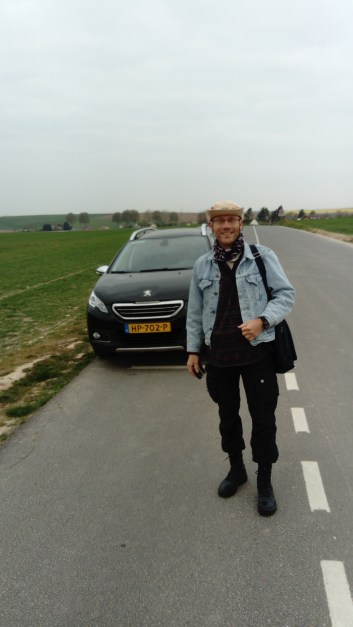
As you can see from his pic, he’s also a paramilitary fan of recreational drugs although he won’t rub your nose in them. I wont judge him, he’s from the Netherlands.
It all started when Marcel said he’d show me around Lochnagar crater: he has been a volunteer there for some years now restoring the place and killing rabbits (who are damaging the crater through their audacious habits of living , digging and procreating – which just makes things worse) with a small knife he keeps in his hat.
The crater is left over from Mine Warfare – a cheeky tactic developed here in the Somme campaign whereby one silently tunnels deep under one’s enemy’s fortified position to create a cave. Fill this cave with over twenty tonnes of explosives and blow the shit out of your unsuspecting victims before sending your troops over the edge to occupy the smoking crater. A hollow victory when it works well but it is quickly apparent that any victory in this battle needs to be cherished. It does go wrong though – as we will see in a bit.
Lochnagar is where one of 19 – or rather 18 as you will read later – huge mines were set to go off at exactly 7:30 am on the 1st of June 1916: ending a week of continuous (literally continuous day and night without stopping) heavy artillery bombardment of the entire patch (a softening up tactic) and signalling the infantry attack. Whistles blew and over the top went thousands.
There’s only three of these mine craters left. After the war the poor bastards that came back to the pile of muddy rocks that used to be their family homes returned to farming. Huge holes tend to get in the way of your spuds so they all got filled in. This crater was spotted all overgrown by a Brit called Richard Denning and to protect what he thought might be the only one left he bought the land off the farmer and set about clearing and preserving it – hence the volunteering work that Marcel (and my hosts) were involved with. Here it lies – free to visit, although sneaky local coach tour operators charge to show it off. This is what 25 tonnes of explosive does (seen 100 years later).
Then we’re off and whilst Marcel is an excellent tale-teller of what went on around these parts he’s the shittiest driver I’ve ever had the misfortune to travel with. Perhaps he’s hoping to get rabbits but actually I think it’s more by luck than judgement that he sticks to the road and we do not become just another statistic in the carnage that took place here. I have to assume that the road from his house to the B&B was built by the Romans who at that time had not invented the lateral displacement speed restriction – or “bend” if you’re not a transport planner.
Another astonishing innovation of the British Army back then was to build their regiments based on where the soldiers were recruited from – so all the volunteers from a town in say, Devonshire, all went into the same happy band to fight alongside their mates and would then be called the Devonshires, for example.
Whilst this was OK up to a point with all pals together and that – there was a downside.
Our next point of call was the Devonshires’ cemetery. Where at a rough count at least 150 men were buried at the place where they exited their trench and carried out their orders: to take the fortified German trenches up on the top of the hill in front of them at Marmetz, just past the machine gun post. Eventually the British Army won that one, but Exeter lost significantly.
We practically drove into the foyer of the Somme museum before ending up in a preserved trench that the Canadian government had the forethought to buy and preserve at the site where they suffered even more than the Devonshires. The pics below show what’s left of the trenches and loads of holes left over from the shelling – remember this is 100 years later. It was close to here that the Hawthorn Ridge crater was within sight.
I say sight – it is completely overgrown and just looks like a little wood on a rise amongst a bunch of fields. There is a famous film (silent) – shot for propaganda purposes – of the preparations for and launch of the Battle and it was shot here. 25:30 into the film and it announces the morning of the Battle. A minute or so later there’s footage of soldiers waiting around in the trench before the battle – this is “sunken road” and Marcel smashed into this place where we stumbled out of his car and looked around (see Marcel in sunken road below) and up on to the ridge above us where the wood is, where once stood the Hawthorn Ridge redoubt (the woods up the hill in the pic – that’s what the soldiers had to get to).


28:05 shows the mine going off – 18 tonnes of explosive. It went off at 7:20 am – ten minutes early. This provided a handy hint to the Germans that an attack was imminent and so just in case they set up along the edge of the smoking crater with machine guns. Ten minutes later whistles blew and yes, you guessed it.
We just have time to walk up the hill and into the woods where finally we can see that there is a crater like Lochnagar hidden in there – wow!
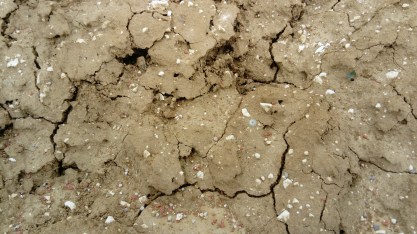 Then we go field walking – across a mud field that has been prepared for sowing but not yet ploughed. It has not rained for a bit as you can see but Marcel says when it’s wet it sticks to everything and just builds up on your boots. The Somme mud.
This is a field that has been ploughed over a couple of times a year at least for a hundred years and after all that you can just walk over it and it is scattered with bits of metal designed to shred the poor bastards that found themselves here. It’s everywhere and it just shows how intense and prolonged the shelling was. Fat lumps of shell casings, bullets, lead shrapnel balls. This is a pic of the soil in the field and pretty much in the centre (slightly to the right) is one of the shrapnel balls looking out at you like little grey marble-sized eyeball. Three hundred of these in an explosive shell. Holy shit.
Marcel found three vertebrae here a couple days before. He has ten hand grenades at home – he uses a hire car when he visits. The farmers still push the unexploded shells to the side of the field and if they turn up any significant proportion of a body (like 50% or something) then everything stops and the war graves people come out and take care of things.
This place is just astonishing.
Marcel “drives” me back to the B&B and have to shoot straight off – I have to say field walking is addictive and Marcel had to drag me away.
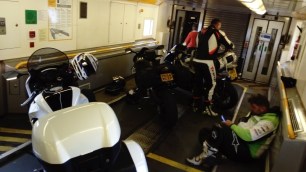 It’s an hour and a half now to Calais tunnel where they insist I take my sunglasses off (not my helmet) at the passport check – then I’m directed to a waiting pen. Here I find the four amateurs from Carcassonne heading home! They are of Eastern European origin (as you can tell from their nonchalant – almost layabout – demeanour; no doubt heading back to finish the building jobs their clients are waiting on.
Then before you know it I’m back on British soil and driving on bumpy crowded and bad tempered roads again. Another long slog back north now but at least I can look forward to a delicious French packed lunch that my hosts prepared for me before I left! Delicious.
Folkestone to Nottingham seemed about the longest leg of the journey.
 The Bonehead's Guide to Advanced Motorcycling
Leave a comment